So we live out in our old van Travel all across this land Me and you
We'll end up hand in hand Somewhere down on the sand Just me and you
Just as free Free as we'll ever be Just as free Free as we'll ever be
We drive until the city lights Dissolve into a country sky Just me and you
Lay underneath the harvest moon Do all the things that lovers do Just me and you
Just as free Free as we'll ever be Just as free Free as we'll ever be And ever be
No we don't have a lot of money No we don't have a lot of money No we don't have a lot of money No we don't have a lot of money No we don't have a lot of money No we don't have a lot of money No we don't have a lot of money All we need is love
We're free as we'll ever be Just as free Free as we'll ever be
So we live out in our old van Travel all across this land Me and you
I just spent three hours stumped in the studio. Inspiration finally struck, and I'm thankful, but I sooo need to get this off my ample chest: ART IS IMPORTANT!!! And so are artists!!! We don't create merely for fun, to avoid "real" work, or as a hobby. It's a calling and a need and a crucial aspect of the overall social construct. Otherwise, would I have spent three hours staring at a piece of paper contemplating the best way to convey a feeling visually? Don't bet on it. And don't tell us it isn't necessary or that we give too much of ourselves to it. That isn't by mistake, it's entirely by design. It's who we are. To quote Shakespeare, "Let me be that I am and seek not to alter me." Your lack of support is a blow to the very heart of us. In the face of so much opposition, it's no wonder we're often lacking in motivation and stumped creatively. A word of advice? Life can't possibly be better with your eyes wide shut, so open them! You'll be glad you did. Meanwhile, we artists will stick together and stay strong.
In preparation for our "Fiber and Fairytales" exhibit, Linda Doucette and I have been dropping yarn bombs in the vicinity of Center and Main Streets in downtown Bloomsburg. We stitched this piece to the tree the other evening just after being interviewed and photographed by the local newspaper. We made the front page of yesterday's edition! So much fun all in the name of art!
Now, when I say "we" stitched, I must include our friend Larry Ney II, who took his turn with the jumbo needle. He actually stitched about half of the piece to the tree. He said his Grammy would be proud. We were impressed too! Good work, Larry!
Linda is just crazy creative! She made these fiber flowers to spruce up the mulch beds.....
.....and mobiles for the tree branches!
(It's a good thing Larry is so tall!)
Lovely.
Painless, pretty graffiti.
One way: Art. Art is the way.
Though time has expired, art is alive and ticking!
Everyone is getting in on the action. Brennan's Rosie looks right at home sporting fiber!
"Fiber and Fairytales" is now at Artspace Gallery through May 19, 2013. Our opening reception is tomorrow, Saturday, April 13, 2o13 from 6 - 8 pm.
“Living artist, glass, steel, mattress, pillow, linen, water and spectacles.”
I saw this performance piece of Tilda Swinton sleeping under glass, during my recent visit to MoMA. She was sooo comfortable being "watched" that she was dead asleep, she was lifeless. I initially thought she was a wax sculpture. Murmurs in the crowd were that she had taken Ambien. She was entirely motionless. You couldn't see her breathing. She didn't move or wake up. The guard shooing people away from the glass and repeatedly barking, "No photos!" led me to believe otherwise. She was very much alive! A human in a glass case. Hmmm..... Anywhere else (on the street, in Starbucks, in a theater) seeing a human being would have been commonplace. Even a sleeping one. Behind (no, surrounded!) by glass and in a prestigious gallery, Tilda became something more. She was art. She was beautiful. She was open for public visual consumption. The fact that she was a celebrity intrigued me. It made me excited. It made me want to look and then look some more. But, reflecting, why on earth? Honestly, the piece entirely brought her back down to my "level". She's just a woman as I am a woman. Thinner and with more acclaim, but still merely flesh and blood.
Usually in the morning I'm filled with sweet belonging And everything is beautiful to see Even when it's raining The sound of heaven singing Is simply joyful music to me Sometimes I feel like a sad song Like I'm all alone without you
So many different places A million smiling faces Life is so incredible to me Especially to be near you And how it is to touch you Oh, paradise was made for you and me Sometimes I feel like a sad song Like I'm all alone without you
I know that life goes on just perfectly Everything is just the way that it should be Still there are times when my heart feels like breaking And anywhere is where I'd rather be
Oh, and in the nighttime I know that it's the right time To hold you close and say I love you so To have someone to share with And someone I can care with And that is why I wanted you to know Sometimes I feel like a sad song Like I'm all alone without you
Sometimes I feel like a sad song Like I'm all alone without you Without you
New York, New York...how I love thee! Let me count the ways: Lexington, Park, Madison, Fifth, Sixth, Seventh and Broadway. And like this "Ragtime" poem (Kevin Young, b. 1970), printed on the back of my MetroCard:
Like hot food
I love you
like warm
bread & cold
cuts, butter
sammiches
or, days later, after
Thanksgiving
when I want
whatever's left
First things first for my friend, the first timer...
The Empire State Building!
Downtown. The Flatiron Building, the Freedom Tower, and Lady Liberty.
The Chrysler Building.
Uptown. Fifth Avenue toward Central Park.
This is not my photo, but we DID visit the Museum of Sex...and MoMA, too, where we saw many amazing works of art. Here are some of my favorites...
Vincent van Gogh (Dutch, 1853-1890)
The Starry Night
Saint Remy, June 1889
Oil on canvas
29" x 36 1/4"
"Looking at the stars always makes me dream," van Gogh said, "Why, I ask myself, shouldn't the shining dots of the sky be as accessible as the black dots on the map of France? Just as we take the train to get to Tarascon or Rouen, we take death to reach a star." -MoMA Highlights, 1999
Mark Rothko (American, born Russia (now Latvia), 1903-1970)
No. 3/No. 13
1949
Oil on canvas
7' 1 3/8" x 65"
Magenta, Black, Green on Orange follows a compositional structure that Rothko explored for twenty–three years beginning in 1947. Narrowly separated, rectangular blocks of color hover in a column against a colored ground. Their edges are soft and irregular, so that when Rothko uses closely related tones, the rectangles sometimes seem barely to coalesce out of the ground, concentrations of its substance. The green bar in Magenta, Black, Green on Orange, on the other hand, appears to vibrate against the orange around it, creating an optical flicker. In fact the canvas is full of gentle movement, as blocks emerge and recede, and surfaces breathe. Just as edges tend to fade and blur, colors are never completely flat, and the faint unevenness in their intensity, besides hinting at the artist's process in layering wash on wash, mobilizes an ambiguity, a shifting between solidity and impalpable depth.
The sense of boundlessness in Rothko's paintings has been related to the aesthetics of the sublime, an implicit or explicit concern of a number of his fellow painters in the New York School. In fact, the remarkable color in his paintings was for him only a means to a larger end: "I'm interested only in expressing basic human emotions—tragedy, ecstasy, doom," he said. "If you . . . are moved only by . . . color relationships, then you miss the point." - MoMA Highlights, 1999
Jackson Pollock (American, 1912-1956)
Number 1A, 1948
1948
Oil and enamel paint on canvas
68" x 8' 8"
While the style of "drip" painting has become synonymous with the name Jackson Pollock, here the artist has autographed the work even more directly, with several handprints. -MoMA Gallery Label Text
While the Bell-47D1 is a straightforward utilitarian craft, its designer, Young, who was also a poet and a painter, consciously juxtaposed its transparent plastic bubble with the open structure of its tail boom to create an object whose delicate beauty is in-separable from its efficiency. -MoMA Highlights, 1999
Barnett Newman (American, 1905-1970)
The Voice
1950
Egg tempera and enamel of canvas
8' 1/8" x 8' 9 1/2"
Abstract Expressionism is often called action painting, but Barnett Newman was one of several Abstract Expressionists who eliminated the signs of the artist's hand. He preferred to work with broad, even expanses of color, as he does here in The Voice. The paint—egg tempera and enamel—is applied so evenly that the only hint of texture comes from the weave of the canvas itself. The broad expanse of white is interrupted only by an off–center stripe of slightly darker white. Similar stripes figure in most of Newman's paintings; he called them "zips." -Curator, Lilian Tone
Andy Warhol (American, 1928-1987)
Campbell's Soup Cans
1962
Synthetic polymer paint on thirty-two canvases
Each canvas 20" x 16"
"I don't think art should be only for the select few," Warhol believed, "I think it should be for the mass of the American people." Like other Pop artists, Warhol used images of already proven appeal to huge audiences: comic strips, ads, photographs of rock-music and movie stars, tabloid news shots. In Campbell's Soup Cans he reproduced an object of mass consumption in the most literal sense. When he first exhibited these canvases—there are thirty-two of them, the number of soup varieties Campbell's then sold—each one simultaneously hung from the wall, like a painting, and stood on a shelf, like groceries in a store.
Repeating the same image at the same scale, the canvases stress the uniformity and ubiquity of the Campbell's can. At the same time, they subvert the idea of painting as a medium of invention and originality. Visual repetition of this kind had long been used by advertisers to drum product names into the public consciousness; here, though, it implies not energetic competition but a complacent abundance. Outside an art gallery, the Campbell's label, which had not changed in over fifty years, was not an attention-grabber but a banality. As Warhol said of Campbell's soup, "I used to drink it. I used to have the same lunch every day, for twenty years, I guess, the same thing over and over again." -MoMA Highlights
2006
When Warhol first exhibited these thirty–two canvases in 1962, each one simultaneously hung from the wall like a painting and rested on a shelf like groceries in a store. The number of canvases corresponds to the varieties of soup then sold by the Campbell Soup Company. Warhol assigned a different flavor to each painting, referring to a product list supplied by Campbell's. There is no evidence that Warhol envisioned the canvases in a particular sequence. Here, they are arranged in rows that reflect the chronological order in which they were introduced, beginning with "Tomato" in the upper left, which debuted in 1897.
Jasper Johns (American, born 1930)
Flag
1954-55 (dated on reverse 1954)
Encaustic, oil, and collage on fabric mounted on plywood, three panels
42 1/4" x 60 5/8"
“One night I dreamed that I painted a large American flag,” Johns has said of this work, “and the next morning I got up and I went out and bought the materials to begin it.” Those materials included three canvases that he mounted on plywood, strips of newspaper, and encaustic paint—a mixture of pigment and molten wax that has formed a surface of lumps and smears. The newspaper scraps visible beneath the stripes and forty-eight stars lend this icon historical specificity. The American flag is something “the mind already knows,” Johns has said, but its execution complicates the representation and invites close inspection. A critic of the time encapsulated this painting’s ambivalence, asking, “Is this a flag or a painting?” -MoMA Gallery Label Text
Jasper Johns (American, born 1930)
White Numbers
1957
Encaustic on canvas
34" x 28 1/8"
Johns sets out to paint commonplace, recognizable objects, the things as he once said, "that the mind already knows," which included maps, numbers, letters of the alphabet, (and) targets. -Curator, Anne Umland
Robert Rauschenberg (American, 1925-2008)
Rebus
1955
Oil, synthetic polymer paint, pencil, crayon, pastel, cut-and-pasted printed and painted papers, and fabric on canvas mounted and stapled to fabric, three panels
8' x 10' 11 1/8"
Rebus belongs to a body of work in which Rauschenberg integrated three-dimensional objects with two-dimensional paintings. His friend Jasper Johns coined the term Combine for such works, describing them as “painting playing the game of sculpture.” Made from layers of everyday materials found in the neighborhood of his Lower Manhattan studio (comic strips, political posters, fabric, and drawings), this work maintains a flatter, sparser surface than most of the artist’s Combines. - MoMA Gallery Label Text
Happy Spring! I know, I know...I'm a tad behind on this one, but that's just how I roll these days! I finally finished all the preliminary stitching on my show pieces and I've begun to paint. I actually finished a triptych of these happy tree pieces in the wee small hours of Spring morning, so technically, I was in under the gun. Blogging about it is another issue. A girl's gotta sleep, right? Otherwise, she starts to look like...
Oh, wait! That's me! Art lets you be who YOU want to be and I'm, well...whatever THIS is (and I like it)!
Yarn donations! Thank you contributors!!! We truly could not do this without your help. Hey, do any of you want to wrap branches???
Leighnah did! Thank you, thank you, Leighnah!
My partner in creativity, Linda Doucette. She is mad talented in the fiber arts and is just an all around great woman. I'm so glad she has agreed to show with me! Visit her at Shades of Nature.
Wrappy happy!
Note the sizeable pile of branches off to the left just waiting to be manipulated...
And what beautiful branches! Many thanks to the friend who cut down these gorgeous Curly Willow branches in the name of art. You're the best!
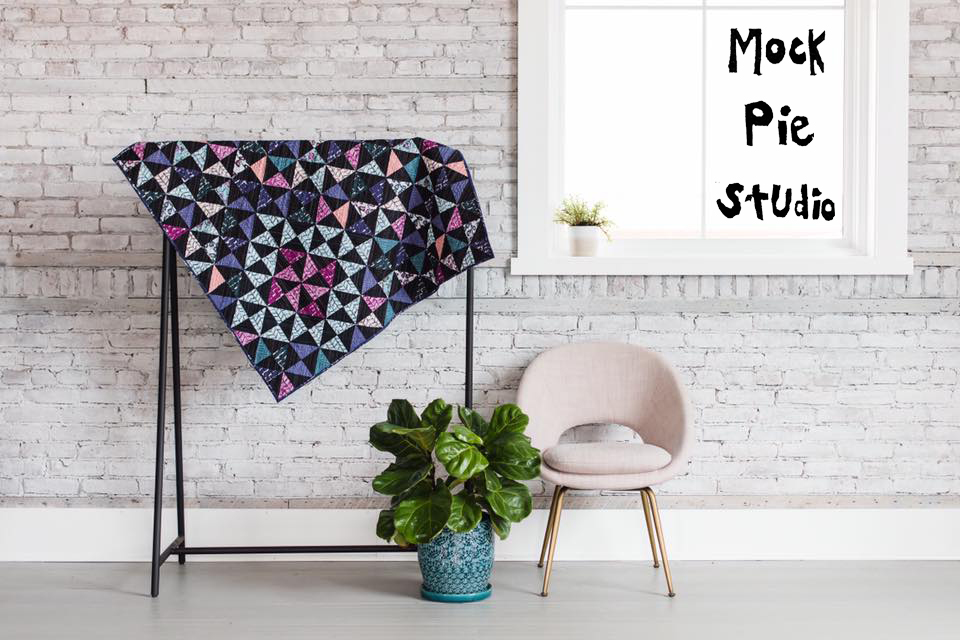
Mock Pie Studio creations feature my original works of art. I am fiber artist Sara Mika. (Pronounced "Me-kuh", not "My-kuh"). "Mock Pie" comes from an interpretation of the quilt as an artistic medium. I am comparing quilts to pie. Like pie, quilts are comprised of two layers filled with so many sweet possibilities. In reality they're only fabric, batting and thread, but I put all of my creative energy into them as well. My quilts are the "Mock Pie" in Mock Pie Studio! Love me. Love my pie.